Monday, April 30, 2012

Baseball at the Academy

Hi, my name is Matthew Karin, a senior at The Governor's Academy, and I will be a guest archives blogger for the next several weeks. I am currently an intern in the Academy’s archives as a part of my senior spring term project. I chose this as my project because I have always loved history and the fascinating stories that go along with it. My first research is on the history of baseball at The Governor’s Academy because of my lifelong career of playing the sport. Information on this history of baseball can also be found in my Cobb Room display and in the archives flyers posted around campus.


The Governor's Academy has a long tradition with baseball throughout its 250-year history. The first known mention of a game of baseball in America was in 1791 in Pittsfield, Massachusetts. Pittsfield is also the site of the first intercollegiate baseball game in 1859 when Amherst defeated Williams College 73-32. The first professional baseball teams in America were founded in 1869 under the modern day National League, however it wasn’t until 1901 that Boston had a professional baseball team: The Boston Americans.

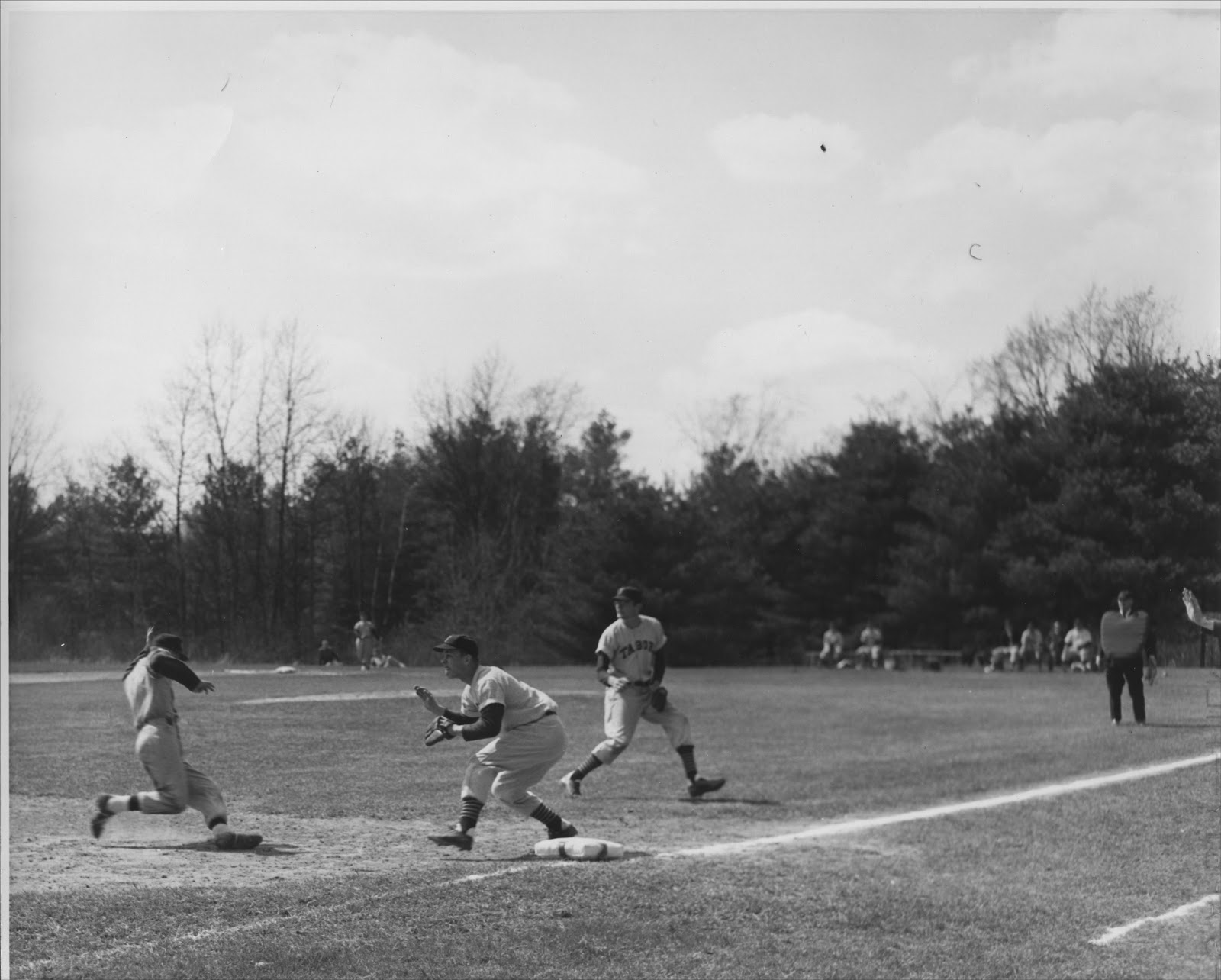
Based on photographs and evidence from the archives, we presume that baseball began at Dummer Academy in the 1870s. The earliest photograph of baseball in the archives is a team picture from 1883, which is comprised of 8 students and 1 coach. At the time, it was not uncommon that coaches participated in baseball games as player-coaches. Both the game itself and its field have changed over the past 140 years. The first change came in 1907 when Captain Ambrose raised money from fellow players to renovate the uneven and unplayable field. Every player donated money towards the project and a member of the Trustees doubled each donation. After Easter break, the new field was ready with several inches of new gravel to level the field and a “skin” diamond was put in. A “skin” diamond is the modern day baseball diamond that has dirt around the base paths. Twenty-five years later, in 1932 the baseball field was rotated from home plate directly in front of Route-1 to its present location. The change was made to “prevent the congestion of traffic caused by passing cars pulling up while the occupants watched the game and also to decrease the number of foul tips which last year went over the backstop and rolled across the road.” Lastly, in 1977 Morse Field was renamed Howard J. Buster Navins Baseball Field in honor of the legendary baseball coach. Buster Navins was a graduate of Dummer Academy who coached soccer, basketball, and baseball for 41 years. He was inducted into the GDA Athletic Hall of Fame in 2005.


Wednesday, April 4, 2012

World War II era- Part II

World War II Era- Part II

As I have written in an earlier blog, Headmaster Ted Eames wrote monthly letters to alumni serving in the military during World War II. These letters range from light and upbeat news of events on campus, to information obtained from other alumni in the military, to deeper, more philosophical letters on the day the atomic bomb was dropped on Hiroshima as well as the day Japan surrendered. It seems clear that alumni did write back to Mr. Eames. Some of these rather dramatic adventures were published in the Archons of that era. Below is one such tale. I hope you enjoy reading it as much as I did.


Friday, March 30, 2012

World War II display


If you liked the last blog about changes taking place on campus during WWII, please check out the new display in the front lobby of the Alumni Memorial Gymnasium. It contains letters from Edward Eames to the troops, first hand accounts from alumni on the front, photographs, newspaper articles, and more!


Friday, March 16, 2012

World War II era at Governor Dummer, part I


Recently, I’ve been combing through the archives’ collection of WWII materials in an effort to put together a display for the front of the Alumni Memorial Gymnasium, a building constructed in honor of those Dummer men who went on to serve the nation during World War II. One of the true treasures in our collection are the letters written by headmaster Eames to those fighting in the war. My sense of Mr. Eames, both from these letters and from my other World War II related archival research, is that he was a man trying to do his duty both as an American citizen as an educator of young men at the time. I believe it was these dual goals that led Eames to make changes to the academy life, both in the form of curriculum changes and the development of the student work program.
The student work program came out of both the necessity of replacing the work of so many that went to either serve in the armed forces or work in war industries. The school simply did not have the personnel available to do the jobs that needed to be done, so headmaster Eames organized a system where each boy was responsible for jobs, both in the morning before classes began, as well as in the afternoon, in place of athletics one afternoon per week. These jobs ranged from cleaning the bathrooms, sweeping and moping hallways and stairways, emptying the trash, and other tasks around dormitory and classroom buildings. Jobs also extended, however, to include outdoor work such as mowing lawns, raking leaves, shoveling snow, lining fields, and clearing brush. Students would have regular daily jobs, special daily jobs, and some weekly and seasonal jobs.
While replacing lost personnel was certainly a motivation behind the development of the student work program, I believe headmaster Eames was also trying to develop students with a work ethic which would serve them well both in the service or whatever the future would bring them beyond the academy.
Less well known than the work program are the curricular changes made by Mr. Eames during the war. In a letter to parents, Mr. Eames acknowledged that because of the war, many students may have to serve in the military before they would normally be able to graduate from the academy. Others would forgo college for military service. He therefore saw it as his duty to prepare his students as thoroughly as possible for military service in particular and the responsibilities of adulthood in general. In order to do this, one of his strategies was to add coursework to the curriculum that would provide students with necessary knowledge and experience for use in the military. Included among the new courses were ones involving the study of Morse Code, navigation, special mathematics with applications in the field of aviation, and mechanics. The description of the new mechanics course in the Archon explains that “knowledge on machines, as well as skill in using and repairing them, is important in almost every phase of modern warfare.”
Above are some of the photographs of students participating in some of the curricular and extracurricular changes that took place as a result of the war. Enjoy these photos, and check back for upcoming World War II blogs including letters written by alumni about their experiences during the war.


Thursday, February 16, 2012

Dancing at the Academy


The history of dance at the Governor’s Academy has been long and not without controversy. While today’s dances can be filled with disagreements about what sort of dress is “appropriate,” all seem to accept the notion that dances are generally a positive part of student life. Not so when dance began at the academy, in Master Moody’s day. Moody decided that bringing a dance instructor to the academy would help his students both get exercise and develop a useful skill. Some of the alumni did not agree with his positive view of dance. One, in a letter to Moody, equated the instruction of dance to working with the devil, and was outraged that such a subject be taught.

In the 20th and 21st centuries, our views on dances have become much more modernized. Even within this narrower time frame, however, dance life at the academy has changed. No longer do we have dance cards listing the fox trot, the waltz, the one step, as the dance card from the 1920 Halloween Dance does. Likewise, a dance today is an evening, rather than an entire weekend event. The schedule from the 1959 dance reveals, with its plan for female guests staying the weekend on campus, that such a short event was not always the norm. Indeed, even looking only at the previous 100 years, our notions of dance have changed.

Thankfully for the archives, we have some wonderful artifacts from these earlier dances that give us a glimpse of student life in earlier times. A new display of some of these is set up currently in the Cobb room right outside the admissions office. If you have a chance, please stop by and check it out. Or email me at sslater@govsacademy.org with your own memories of campus dances.


Thursday, January 5, 2012

a History of Hockey at the Governor's Academy

First Girls' Hockey Team, 1985


1950's Hockey Practice Without Ice


1922 Varsity Hockey


1885 Roller Polo


The recent cold spell has put winter on my mind, as well as winter sports, which have a fairly long history here at the Governor's Academy. While ice hockey began as a sport in Canada in the mid to late 1800's, we have no records of the sport being played here that early. The earliest signs of hockey on campus began in 1885, when the academy sponsored what was known as roller polo, the precursor to roller hockey. By the 1920's, when the NHL had its first games in the US, Governor Dummer had its first ice hockey teams, both varsity and junior teams. These boys' teams played for many years until finally, in 1985, 14 years after the first girls were admitted to the academy, the boys were joined by the first girls' ice hockey team.


Hockey has also changed venues several times during its history at the academy. Players have played on a pond near Parsons, a rink next to Ingham, an outdoor rink, later enclosed, behind Perkins, and their current luxurious accomodations in the Whiston-Bragdon arena. For those who are able, a display of photographs related to our school's hockey history, along with newspaper clipping and skates from 1950 alum Charles Bowen, are on display currenly in the Phillips Building display case in the Cobb Room. Please stop by and check them out. For those of you unable to pass by the Cobb Room display, a sampling of photos from the display are included above.


Friday, December 9, 2011

Holiday Greetings

As Christmas draws near and many of us begin to address cards to friends and family, we find we share this task with many of the academy’s past headmasters and their families. The Governor’s Academy archives is fortunate to have some of these cards sent by headmasters Ingham (1907-1930), Eames(1930-1959), Wilkie(1959-1973), and Doggett(1999-2011) among its collection. Interestingly enough, while most of the cards sent were Christmas cards, the Eames family seemed to prefer sending New Year’s cards (perhaps as a way of giving themselves a little extra time to send their greetings.) Currently, many of these past greetings are on display in the Cobb Room in the Phillips Building and will remain there until after New Year’s. We encourage all who can do so to visit. For those who cannot, a small sampling of the items on display is included below.